
Nitrile is widely used wherever reliable protection is needed, including in disposable medical gloves and occupational protective gloves. The raw material goes through several stages of petrochemical production before it becomes a finished glove.
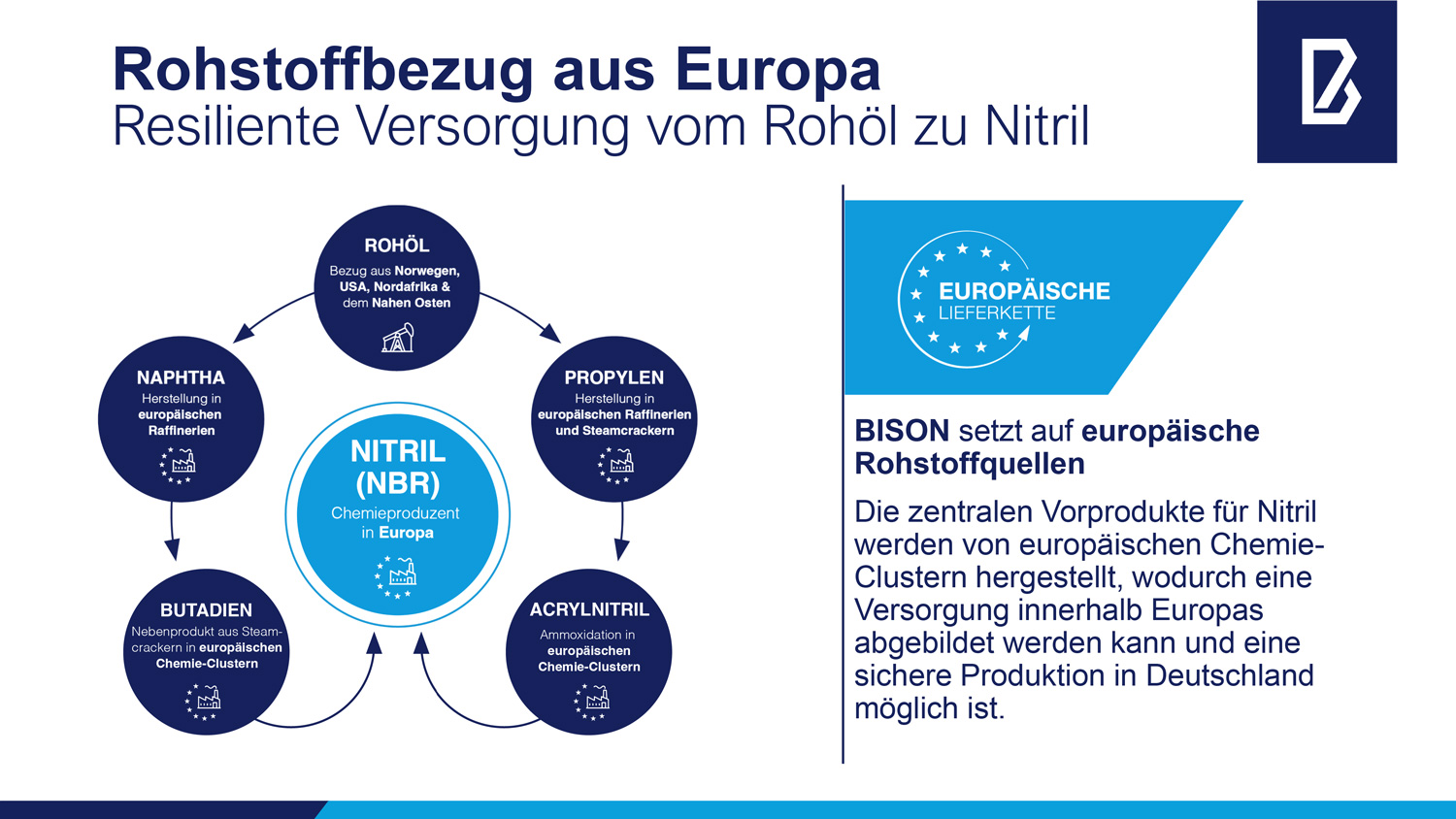
Fossil feedstocks are converted through intermediates such as naphtha, butadiene and acrylonitrile into nitrile butadiene rubber, or NBR.
Supply security depends on where a glove is made as well as where its raw materials and intermediates come from.
Key Points at a Glance
Nitrile butadiene rubber, or NBR, is made from butadiene and acrylonitrile. Both are produced from fossil feedstocks through several stages of petrochemical processing.
Where these raw materials and intermediates are made affects transport routes, dependencies and the stability of the supply chain.
Regional sourcing of raw materials can therefore make an important contribution to the security of supply for nitrile disposable gloves.
Contents
- What Is Nitrile?
- How Is Nitrile Made?
- From Crude Oil to Butadiene and Acrylonitrile
- Where Are Nitrile Intermediates Made?
- Why the Origin of Raw Materials Matters for Disposable Gloves
- How Quickly Raw Material Supply Chains Came Under Pressure in 2026
- Benefits of a European Supply Chain
- German Manufacturing and a European Value Chain
- What Does This Mean for Nitrile Disposable Glove Procurement?
- Conclusion: Supply Security Starts With the Raw Materials
- Frequently Asked Questions About Nitrile Production
What Is Nitrile?
Nitrile is a synthetic rubber. The material used in nitrile disposable gloves is more precisely called nitrile butadiene rubber (NBR). It is made from two basic components, acrylonitrile and butadiene.
NBR is particularly valued for its mechanical strength and resistance to many oils and chemicals. These properties make it suitable for a range of applications, from industrial seals and hoses to protective and disposable gloves.
In disposable glove production, NBR is processed in liquid form. This makes it possible to create a thin, durable layer of material.
Several production steps are therefore needed to turn the original feedstocks into nitrile rubber.
How Is Nitrile Made?
Nitrile butadiene rubber (NBR) is made by polymerising butadiene and acrylonitrile. Both starting materials are produced from fossil feedstocks through several upstream petrochemical processes.
The industrial history of nitrile rubber goes back to the 1930s. Since then, production plants, processes and formulations have been substantially refined for large-scale manufacturing. The underlying chemistry has remained similar and still relies on butadiene and acrylonitrile.
The route to finished nitrile rubber can be shown in simplified form as follows.
Fossil feedstocks → Naphtha → Steam cracking → Butadiene and propylene → Acrylonitrile → NBR → Nitrile disposable glove
(This is a simplified representation. Petrochemical feedstocks and intermediates can be produced by different routes.)
From Crude Oil to Butadiene and Acrylonitrile
Crude oil is the starting point of the petrochemical value chain. Refineries separate it into different fractions and products through distillation and further processing. One of those fractions is naphtha.
Naphtha is an important feedstock for the petrochemical industry. Steam crackers use high temperatures and steam to split it into smaller molecules. The process produces a mixture of basic petrochemical products.
From here, two routes are relevant to nitrile production. One leads to butadiene and the other leads to acrylonitrile via propylene.
How Is Butadiene Made?
Butadiene can be recovered from the C4 hydrocarbons produced when naphtha is steam cracked. Extraction and separation processes then isolate and purify the butadiene.
Butadiene is an important feedstock for the chemical industry. Besides NBR, it is used to make other synthetic rubbers and plastics.
The availability of butadiene depends on more than demand for nitrile. Changes at refineries or steam crackers and in other major markets can also affect supply and prices.
How Is Acrylonitrile Made?
Most industrial acrylonitrile is made by the ammoxidation of propylene. Propylene reacts with ammonia and oxygen, typically supplied as air, in the presence of a catalyst.
Alongside butadiene, acrylonitrile is the other essential building block of NBR. Its production starts with propylene, a major petrochemical feedstock that can be obtained through steam cracking, among other routes.
Acrylonitrile is an important chemical intermediate used in nitrile rubber and in products such as certain plastics and fibres.
How Are Butadiene and Acrylonitrile Turned Into NBR?
Nitrile butadiene rubber (NBR) is made by polymerising butadiene and acrylonitrile. The two starting materials join to form long molecular chains, creating the synthetic rubber used to manufacture nitrile disposable gloves.
The route from the original feedstock to the finished glove is therefore considerably longer than the end product might suggest.
Where Are Nitrile Intermediates Made?
Nitrile intermediates are produced at major chemical plants and refineries around the world. Both Asia and Europe have significant production capacity.
In Asia, many of these chemicals go directly into regional production of nitrile and other industrial products. Availability and export volumes can therefore fluctuate when regional demand is high or disruptions occur.
Europe also has production capacity for important intermediates such as butadiene and acrylonitrile. For European buyers, regional sources can help reduce dependence on Asian supply chains and strengthen supply security.
Why Does the Origin of Raw Materials Matter for Disposable Gloves?
The origin of raw materials affects transport routes, geographical dependencies and supply chain stability. The more materials and intermediates depend on individual regions or critical trade routes, the greater the potential supply risk during a disruption.
Significant risks remain when raw materials and intermediates are shipped across several continents or depend on individual critical trade routes. Examples include
- geopolitical conflicts
- restrictions on shipping routes and ports
- shortages of petrochemical intermediates
- sharp fluctuations in energy and raw material prices
- production outages at refineries and chemical plants
- long transit times
- shortages of shipping and container capacity
These risks are particularly relevant when several production stages are concentrated in the same areas.
Working with multiple suppliers can improve resilience if raw material sources, production sites and transport routes are also sufficiently diversified.
How Quickly Raw Material Supply Chains Came Under Pressure in 2026
The events of 2026 once again showed how important these dependencies can be.
The escalation of conflict in the Middle East temporarily disrupted traffic through the Strait of Hormuz. This was particularly significant for the Asian petrochemical industry, since a substantial share of the region’s naphtha imports comes from the Middle East.
The effects were felt across the value chain. Naphtha became scarcer and more expensive, some steam crackers reduced output, and the availability of propylene and butadiene came under pressure.
This matters for nitrile production because these chemicals are at the beginning of the production chain. Raw material disruptions can ultimately affect the availability of finished nitrile disposable gloves.
European sourcing cannot eliminate every global risk. Shorter transport routes, regional raw material sources and reduced dependence on critical trade routes can nevertheless make supply chains considerably more stable and predictable.
Benefits of a European Supply Chain
A European supply chain offers several benefits.
- Shorter transport routes and reduced dependence on long sea routes
- Less geographical dependence on individual regions of the world
- Better visibility into material origins and upstream production stages
- Faster responses to changes in demand and availability
These factors can make supply chains more stable and predictable, particularly for critical products such as disposable gloves. Regional raw material sources complement global supply chains by providing additional security and reducing dependencies.
German Manufacturing and a European Value Chain
At BISON Polymers, we deliberately use European raw material sources to manufacture our nitrile disposable gloves in Germany. This shortens transport routes, reduces dependence on trade routes outside Europe and improves transparency across the supply chain. For our customers, this primarily means greater predictability and a more stable supply of nitrile disposable gloves.
What Does This Mean for Nitrile Disposable Glove Procurement?
When sourcing nitrile disposable gloves, buyers should consider the origin of raw materials, transport routes and upstream production stages alongside price and manufacturing location. A transparent and geographically diversified supply chain can help reduce supply risks.
Strategic procurement decisions benefit from a closer look at the entire supply chain. Specific questions can help identify dependencies and assess potential supply risks.
Questions worth asking include
- Where is the finished glove manufactured?
- Where is the NBR used to make it produced?
- Where do the acrylonitrile and butadiene come from?
- How far are materials transported between production stages?
- Which sea routes and logistics hubs does the supply chain depend on?
- Are alternative raw material sources or production sites available?
- How much visibility can the supplier provide into its upstream supply chain?
Conclusion: Supply Security Starts With the Raw Materials
A nitrile disposable glove may look like a relatively simple consumable. Manufacturing it depends on a complex petrochemical value chain.
Refining and cracking fossil feedstocks produces materials including naphtha, propylene and butadiene. Propylene is used to make acrylonitrile. Butadiene and acrylonitrile are the chemical building blocks of NBR, which in turn can be used to make nitrile disposable gloves.
Each stage is part of the supply chain and can affect the availability of the finished product.
The events around the Strait of Hormuz in 2026 show how quickly disruptions to energy and raw material flows can spread to the petrochemical industry.
For procurement teams, assessing supply security for nitrile disposable gloves means looking beyond the location of the glove factory to the upstream supply chain.
European raw material sources, regional production and shorter transport routes cannot remove every global risk. They can help reduce dependencies, improve transparency and create additional supply options.
Author
Andreas Zimmer
Social Media & Content Creator at BISON Polymers
Frequently Asked Questions About Nitrile Production
What Is Nitrile Made From?
Nitrile butadiene rubber, or NBR, is made from two monomers, butadiene and acrylonitrile. In conventional petrochemical supply chains, both are produced by upstream chemical processes.
How Is Nitrile Made?
To make NBR, butadiene and acrylonitrile are polymerised to form a synthetic rubber. Disposable glove production typically uses an NBR latex dispersion to create the thin glove film.
How Is Butadiene Made?
Butadiene can be recovered from C4 streams produced when naphtha is steam cracked. It is then isolated and purified from the C4 mixture using extraction and separation processes.
How Is Acrylonitrile Made?
Most industrial acrylonitrile is made by ammoxidation. Propylene, ammonia and oxygen, typically supplied as air, react in the presence of a catalyst.
Why Does the Origin of Raw Materials Matter for Nitrile Disposable Gloves?
The origin of raw materials affects transport routes, dependence on particular regions and supply chain stability. Disruptions to naphtha, butadiene, propylene or acrylonitrile supplies can affect nitrile availability after passing through several production stages.
What Are the Benefits of a European Supply Chain?
A supply chain with more stages in Europe can shorten transport routes, reduce dependence on particular regions and improve transparency. This can make supplies of critical products more secure and predictable.
Are Nitrile Disposable Gloves Manufactured in Germany?
Yes. BISON Polymers manufactures nitrile disposable gloves in Germany. Together with European raw material sourcing, this keeps a substantial part of the supply and value chain within Europe.

“More than just gloves” – BISON profiled by Klinik Einkauf
How does a vision come about? What does it take to rethink disposable gloves – regionally, responsibly, and at the highest technical level? Klinik Einkauf reported on exactly this in its current issue – and presented BISON Polymers in a detailed portrait. At the...

BISON Recruiting Bus on the Road in Siegen
#GetInNow with BISON – Campaign to Secure Skilled Workers Launched Since July 2025, a strikingly designed bus has been traveling with the message“We are taking the future into our hands” through Siegen. With this campaign, BISON Polymers is drawing attention to...

BISON Publishes Article in “Management Hospital”
How supply security in medical technology can be reimagined – BISON Polymers highlights this in a recent report published in the trade journal Management & Krankenhaus. The focus is on the question of how regional production can contribute to stable supply chains,...

Sustainability Begins with Responsibility – BISON Focuses on Production in Germany
Short delivery routes, controlled processes, modern facilities: At BISON, sustainability is not an add-on, but part of the company's DNA. The Siegen site demonstrates how supply security and environmental responsibility can go hand in hand. Ecologically...

Disposable gloves and sustainability – quo vadis?
Disposable products and sustainability – do they even go together? This question is particularly relevant for medical and industrial consumables like nitrile gloves. However, the answer is more nuanced than it might seem at first glance. In this article, we examine...

Powder-free gloves – for good reason
In the past, powdered disposable gloves were considered standard – today they are even prohibited in many areas. BISON consistently focuses on powder-free nitrile gloves – and does so out of conviction. In this article, you'll learn why powder is problematic, what...

How to use disposable gloves correctly – here’s how
Disposable gloves are part of daily protective equipment in medicine, care, laboratory and industry - yet they are often used incorrectly in everyday life. The correct handling determines the protective effect, skin compatibility and hygiene. This article shows what...

Nitrile or latex? An overview of pros and cons
Choosing the right glove material is crucial in the healthcare and industrial sectors – for protection, comfort, and skin compatibility. But what exactly are the differences between nitrile and latex gloves? We show the properties of both materials, where their...

Hand protection and skin care in everyday hospital, practice, and nursing settings
Constant hand washing, disinfecting, wearing disposable gloves – this is part of everyday life for employees in medical and nursing fields. But what protects those who protect? In this article, we show what really matters in hand protection and skin care – and how you...

Allergy risk from disposable gloves – what you should know
Disposable gloves are meant to protect - but not every skin tolerates every material. In clinics, care facilities, laboratories or cleaning, skin reactions triggered by powder, latex or additives occur repeatedly. This article explains where allergy risks lie...